
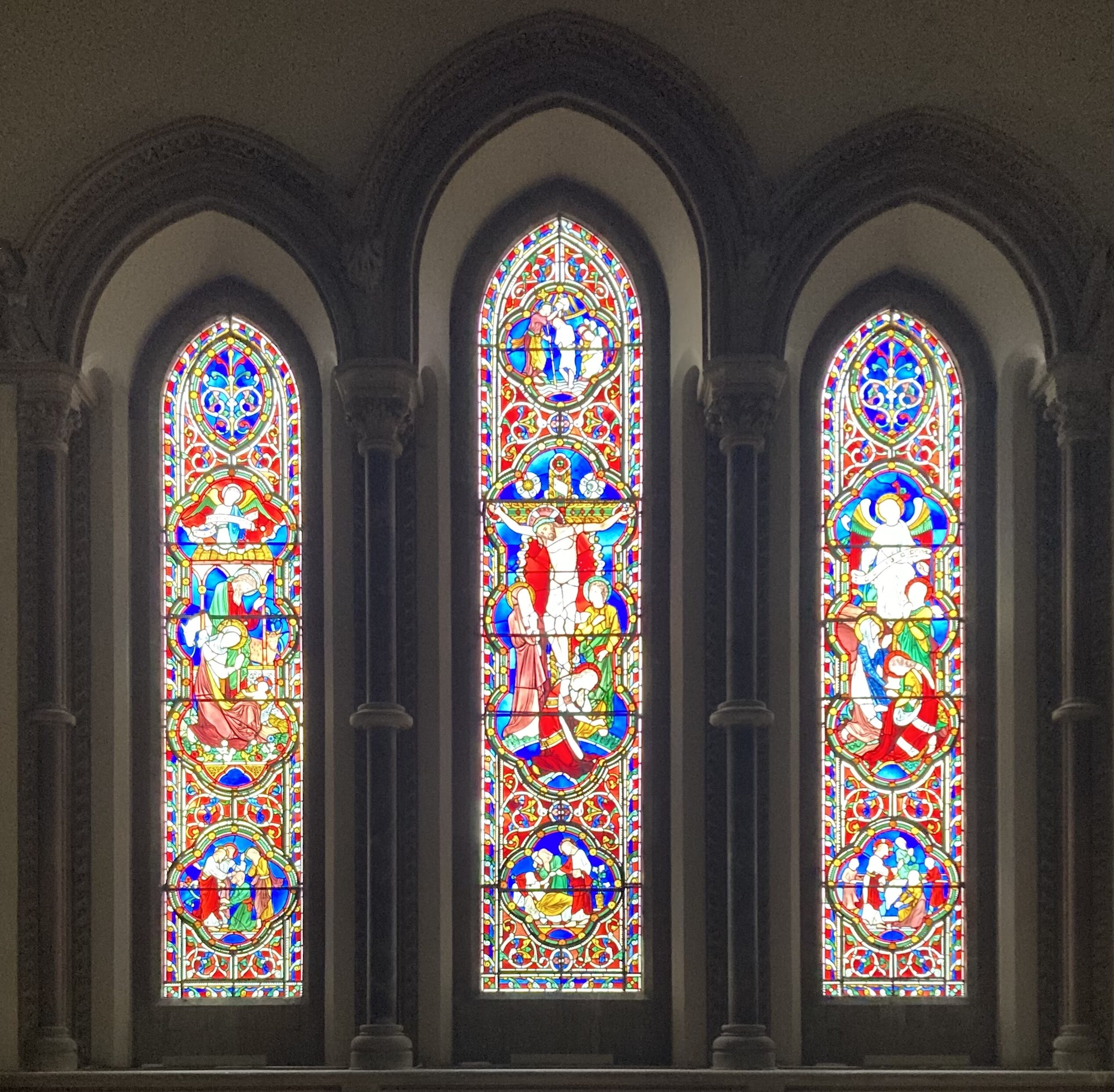

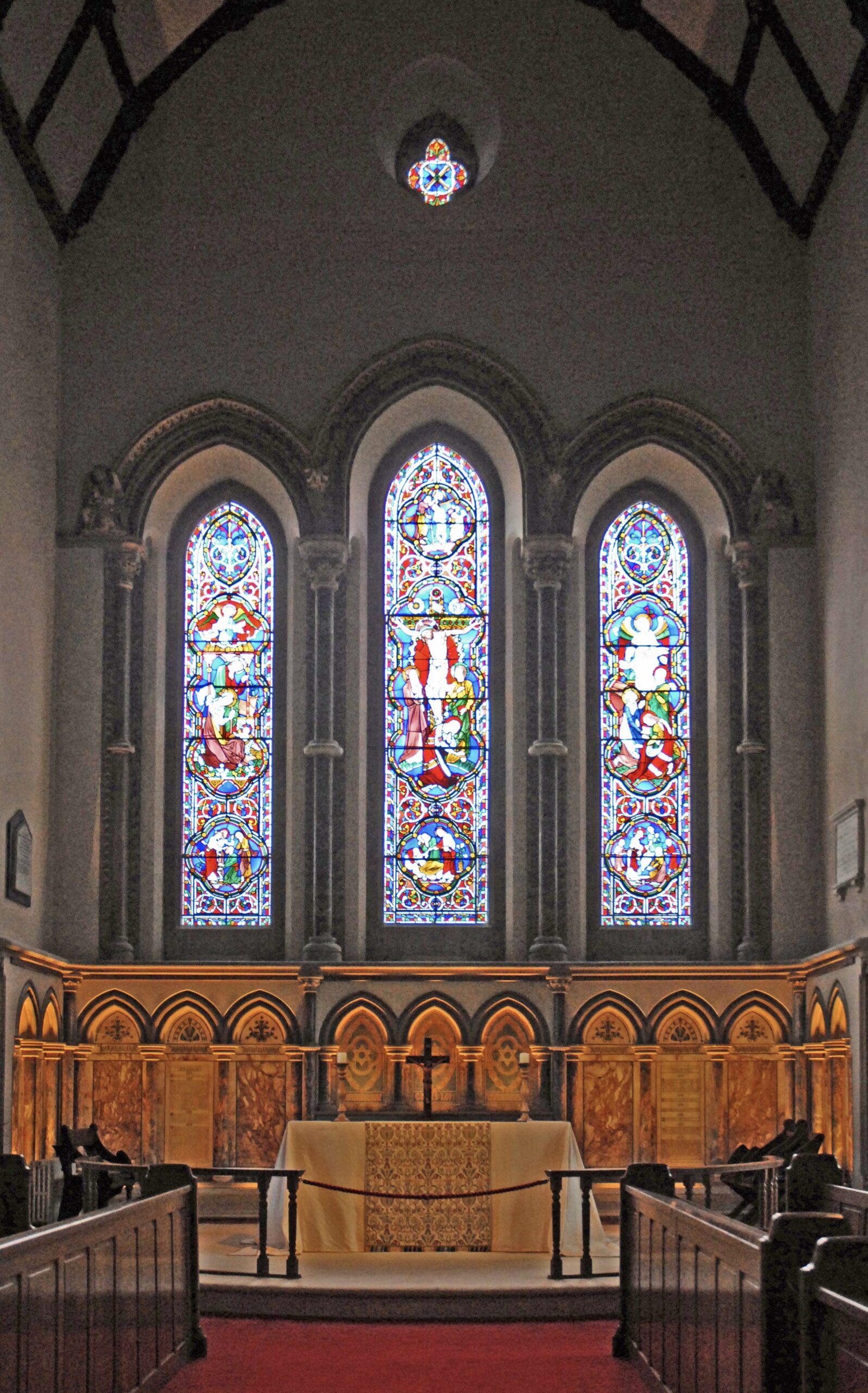
Our East Window, the Work of Hardman & Co.
Our largest window, above the high altar, dominates the chancel. It was installed in 1863/64 after the east wall had been rebuilt by the Chichester Diocesan Surveyor, Gordon Hills (1826-1895), who had been called in to rescue the building from potential collapse. Hills’ new east end included a new window of three lancets, in the Early English style. Click on the above image to see more photographs.
The new, brightly coloured glass must have had an enormous visual impact at the time as this was the first large stained-glass window to be installed in our church since the Reformation. The glass was made in the Hardman workshops in Handsworth, then in Warwickshire, now part of Birmingham. The Hardman family’s ‘Mediaeval Art Manufactory’ had been established with the encouragement of the leader of the Gothic revival, Augustus Pugin (1812-1852), and pioneered the early revival of the lost craft of stained-glass manufacture.
This window is typical of the Hardmans’ earlier style, which emulated the early medieval glass found in the large windows of England’s cathedrals and greater churches, such as at Canterbury.
The central panels of each of the three lancets depict key scenes from the life of Christ, the nativity to the left, the crucifixion in the centre, and the women at the sepulchre, hearing the instructions of an angel, to the right. At the top of the central light, Jesus is baptised by John. The lower panels show three of Christ’s healing miracles. It took many years for the art of stained-glass manufacture to be perfected, and some of the glass painting has faded, especially the tracing of some faces.
The window is a memorial to Hugh Ingram, a local magistrate, the gift of his widow.
The small window above the east window was ordered from Hardmans at the same time, and depicts St Andrew’s cross. The quatrefoil window opening had been constructed in 1846, originally glazed with other coloured glass.
Hardmans were also responsible for the other nineteenth century figurative stained glass in the church, which was installed within a new window under the west tower in 1870. Two large medallions depict Jesus blessing the little children, and as the Good Samaritan, respectively. At the top, a quatrefoil within a circle depicts the Lamb and Flag (a heraldic symbol of the victorious Passover Lamb, as described in Revelation 7.). Again, much of the line painting has faded badly. Because of the installation of vestries under the tower in the 1980s, this west window it is not usually accessible to the visitor.